Patient safety, infection control, and legal accountability all rest on the quality of the physical environment in a healthcare setting. Healthcare fit-out standards in the UK are not optional guidance. They are the framework within which every hospital fit-out, clinic refurbishment, and medical construction project must operate, backed by regulatory powers that providers cannot delegate away.
The problem is that the framework is frequently misunderstood. A refurbishment that looks finished and professional can still leave a provider non-compliant, legally responsible for any shortfall, regardless of who carried out the build. A fit-out that falls short of what Health Technical Memoranda (HTM), Health Building Notes (HBN), and Care Quality Commission (CQC) regulations require does not just create a difficult inspection conversation. It creates long-term liability.
Understanding what each part of the framework requires is what separates a compliant project from one that creates problems after handover.

What Are Healthcare Fit-Out Standards in the UK
Healthcare fit-out standards in the UK are the set of technical, regulatory, and design requirements that govern how healthcare environments must be built, refurbished, and maintained. Three bodies define this framework, and each one covers different ground.
A compliant project requires all three to be considered together.
Health Technical Memoranda (HTM)
HTMs are issued by the National Health Service (NHS) England and set the technical requirements for healthcare building systems. HTM 03-01 (2021) covers ventilation in premises providing acute care, directly relevant to hospital fit-outs, operating theatre refurbishments, and any environment where infection control depends on controlled airflow [1].
The memorandum runs to two parts:
- Part A covers design and validation for new installations and major refurbishments.
- Part B addresses operational management and performance verification.
- For settings outside acute care, a risk assessment must determine how the guidance applies before work begins.
HTMs are not aspirational standards. Any medical construction project that falls short faces both regulatory exposure and real clinical risk.
Health Building Notes (HBN)
Where HTMs govern engineering systems, HBNs govern the planning and design of healthcare spaces. HBN 15-02 covers same-day emergency care facilities, defined as patient care with investigation and treatment within the same day for non-elective patients who would otherwise have been admitted to a hospital bed [2].
The guidance is direct about the design stakes. A well-designed SDEC unit manages patients with minimal delays, with good patient flow central to clinical safety and staff welfare.
That framing matters for any healthcare refurbishment. Layout decisions in a clinical environment are operational, not spatial. How people move through a building under pressure is a clinical safety question.
Care Quality Commission (CQC) Requirements
The CQC inspects and regulates health and social care providers in England. Regulation 15 of the Health and Social Care Act 2008 (Regulated Activities) Regulations 2014 sets the legal requirement for premises and equipment. Chiefly, they must be clean, secure, suitable for purpose, properly maintained, and appropriately located [3].
One aspect that catches providers out is that responsibility for meeting these standards rests with the provider, not the contractor, even where the work has been delegated through a supply chain.
The CQC must refuse registration to any provider that cannot demonstrate compliance with Regulation 15, and, where standards are not met, it can take regulatory action. Any alterations to premises must be made in line with current legislation and guidance. Where that guidance cannot be met in full, providers must have contingency plans in place to manage the risk to people using the service.
What Every Compliant Healthcare Fit-Out Must Address
The details vary by project type and setting. These areas apply across virtually every medical refurbishment or hospital fit-out:
- Surfaces, flooring, and wall panels must be impervious, cleanable, and suited to the clinical environment. Infection control starts with material selection.
- Ventilation supply and extract rates, pressure differentials, and filtration standards must be designed into the project from the outset, not addressed after the build.
- Corridor widths, door clearances, and toilet provision must meet building regulations and the specific requirements of the patient cohort using the space.
- Materials must withstand clinical cleaning regimes, and the building fabric must allow maintenance work without disrupting clinical activity.
- The layout must support how clinical teams actually work. Poor circulation design is a safety issue, not an inconvenience.
Our healthcare and medical sector work covers these requirements from the outset. CDM compliance, detailed method statements, and direct communication throughout give clients confidence that standards will be met without disrupting the facility’s day-to-day operation.
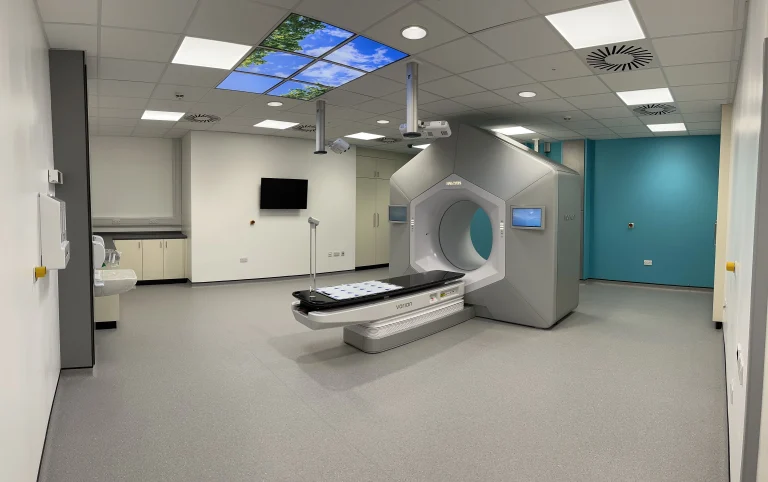
Plus, our health and safety accreditations, including ISO 45001:2018, SafeContractor (SSIP), and CHAS, reflect the same compliance principles that underpin these standards. Our refurbishment work at Lincoln Hospital involved a live radiotherapy environment where ventilation sequencing was critical to both infection control and programme delivery.
The Real Cost of Getting Healthcare Compliance Wrong
Non-compliance in healthcare construction is not a paperwork problem. The CQC has a wide set of enforcement powers, including Warning Notices, Notices of Proposal and Decision, and urgent cancellation orders. For NHS trusts and foundation trusts, Section 29A Warning Notices can be served where the quality of healthcare needs significant improvement [4].
That enforcement reach covers the physical environment. A fit-out that leaves a provider unable to meet regulatory standards creates the conditions for enforcement action against a facility believed to be fit for purpose. Sound project management with compliance built in from survey to handover is what separates a solid fit-out from long-term liability.
Our NHS appointment record reflects the same compliance principles. The Halcyon Varian system installation at Colchester Hospital required CDM-compliant delivery in an operational clinical environment with zero disruption to adjacent services.
Work With a Healthcare Fit-Out Partner Who Knows the Standards
Without a clear understanding of healthcare fit-out standards, a refurbishment can appear complete while leaving a provider exposed, non-compliant with Regulation 15, and facing CQC enforcement action. With the right contractor, those risks are addressed before they arise.
Rocare is an approved contractor for NHS Trusts and Local Health Authorities, with over 40 years of experience across ward refurbishments, laboratory upgrades, reception spaces, and private medical facilities across the South of England. Our directly employed workforce and vetted supply chain have delivered in occupied healthcare environments where the margin for error is small, and the standards are not optional.
Speak to our team about your upcoming project by calling 01425 482000 or using our contact form to discuss your requirements directly.
External Sources
[1] GOV.UK, National Health Service (NHS) England, Health Technical Memorandum 03–01: Specialised Ventilation for Healthcare Premises (2024): https://www.england.nhs.uk/publication/specialised-ventilation-for-healthcare-buildings/
[2] GOV.UK, National Health Service (NHS) England, Health Building Note 15–02: Facilities for Same Day Emergency Care/Ambulatory Emergency Care (2024): https://www.england.nhs.uk/publication/facilities-for-same-day-emergency-care-ambulatory-emergency-care-hbn-15-02/
[3] Care Quality Commission (CQC), Regulations for Service Providers and Managers, Regulation 15: Premises and Equipment (2025): https://www.cqc.org.uk/guidance-regulation/providers/regulations-service-providers-and-managers/health-social-care-act/regulation-15
[4] Care Quality Commission (CQC), Enforcement: https://www.cqc.org.uk/guidance-regulation/providers/enforcement